The Hunt for a Comet
October 10, 2020
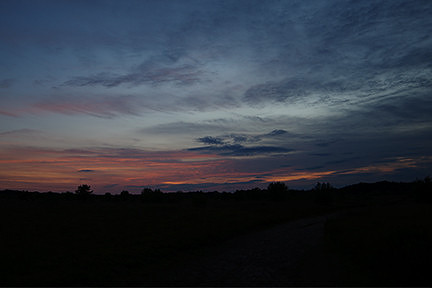
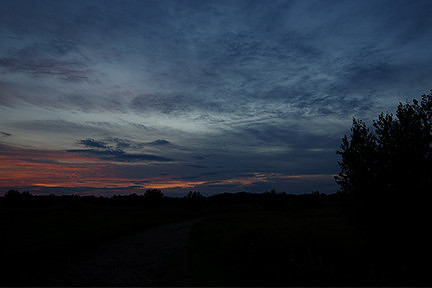
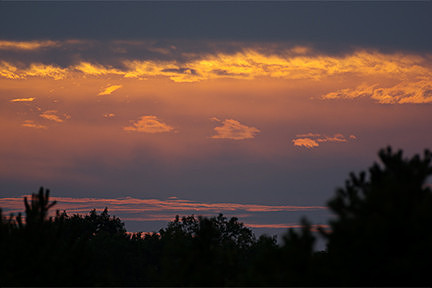
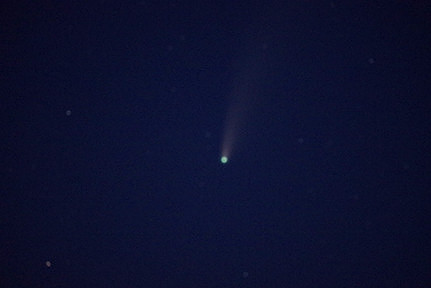
In mid-July 2020, I started seeing photographs in my feeds on social media of a comet. At first, I didn’t really think anything of it. Then, I watched a short video on YouTube where I learned that this comet, C/2020 F3 (NEOWISE), had just been discovered in March and had such a huge orbit, it would not be visible from Earth for another 6700 years or so! I spent a large portion of that Saturday researching as much as I could about the comet, how to find it, and how to photograph it. From everything I was reading, it would only be visible for about another week, but they weren’t sure exactly when it would fade out completely. This was a once-in-a-lifetime opportunity, so I had to try. The folks at NASA were recommending going out about 45 minutes after sunset and looking in the area of the northwest sky below the Big Dipper. Depending on how far north you were and how much light pollution there was in your area determined how well you could see it with the naked eye and how bright it appeared. I saw photos that were taken with wide-angle lenses, usual for astro and night photography, but also with ‘normal’ lenses and even telephoto lenses. Many photographers were stating that the 300mm range was ideal with an exposure time of only 1 second. I was pretty amazed at those settings but was willing to try. Every camera and lens combination handles light differently, so I knew I’d have to try a lot of different options to see what worked for me. It was clear skies all day, so I was looking forward to my chances for that evening. My plan was to go out with a few camera bodies and lenses to experiment and learn. It was forecast to be clear the following day, as well, so hopefully I could apply what I learned to get better photos the second night. It was a good plan, but as we all know, plans often don’t work out. Sunset was scheduled for 8:18pm that evening with blue hour starting at 8:39pm, nautical twilight at 8:52pm, astronomical twilight at 9:36pm, and full nighttime starting at 10:27pm. I loaded my Pentax K3-II and Pentax K1 into the jeep, along with my 150-450 and 14mm lenses. I’d only ever used the K1 once for astrophotography, but it was billed as being great for it. My K3-II had been used several times before, and I’d been impressed with those results, so I was hoping to double my chances. I left the house at 8pm and drove out to the Blueberry Plains between Kennebunk and Sanford. The comet was supposed to be relatively close to the horizon, though it would be higher in the sky each night as the days progressed. As such, all the experts had recommended looking for locations where any trees and/or buildings would be far enough back to be relatively small and therefore would not obstruct it from view. I was hoping the geography of the Blueberry Plains would fit the bill and provide good viewing of the appropriate section of sky. As the name suggests, the area was wide-open with sparse low-lying vegetation, and the treeline to the northwest was a good distance away. Unfortunately, when I got to my location, I discovered a lot of cloud cover to the northwest. I was there in time to see the clouds light up with some beautiful sunset color, but I didn’t have any of the right lenses for that type of photography. I took a few photos, anyway, then set about to wait. As it grew darker, the mosquitoes showed up, so I took shelter inside my jeep. As the evening wore on, other vehicles started arriving. Some hung around to wait, while others left shortly after arriving. There were somewhere between 6 and 12 that showed up over the course of the evening, all told.
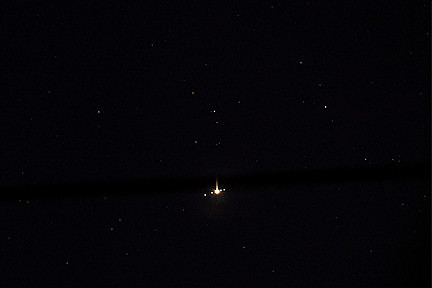
As it grew later, some gaps started appearing along the edges of the clouds. I climbed out to start searching the sky. I wasn’t sure where exactly to look, though. The compass on my phone didn’t agree with the compass in my jeep, and I still couldn’t see the Big Dipper. There was a surprising amount of traffic on the road, so the headlights kept messing with our night vision. One lady said she’d seen it the other night, so she was able to point us in the general direction. By 9:30pm, we were finally able to see the Big Dipper. Behind us, Saturn and Jupiter were shining brightly, Jupiter the brighter of the two. As we continued to watch the sky, we saw a few shooting stars, some lightning bugs, some airplanes and random satellites, and the ISS (International Space Station), but no comet. The edge of the cloudbank was just below the Big Dipper and blocked any view we might have had of the comet. The few folks that had stuck around all started to head out, and eventually, I was the only one left. By 10:30pm, the clouds had fully blocked even the Big Dipper from view, so I packed up and headed home, hoping for better luck the next night. The following day, July 19th, all of the times for the different phases of darkness were roughly the same, so I knew I wasn’t likely to see anything until at least 9:30pm or so. However, I hadn’t been feeling all that well throughout the day, so by late afternoon, I had to make a choice. Either I was going to leave early, or I wasn’t likely to go at all. Given the forecast for the rest of the week and the fact that working would make it difficult to stay out late, I knew I had to go for it. It could very well be my last chance to see the comet, ever. I packed up my gear once more, this time leaving around 6pm. I headed back to the Blueberry Plains, and unsurprisingly, I was the only one there. I’ve heard that area can be great for bird sightings of a different variety than I’ve seen along the coast and marshlands, so I was hoping to try my luck. I grabbed my K3-II, big lens, and tripod, and set off on one of the main trails. When I came to a junction, I decided to set up there and wait and watch. It was very peaceful and relaxing, though I didn’t see much in the way of birds. Once again, there was a large bank of clouds to the north and west. I wasn’t sure if I was going to have any luck, but it made for a nice sunset. Like the previous day, I didn’t have the right lens, but I took quite a few photos and even a little video anyway. After the best of the sunset color had faded, I headed back to the parking area and sheltered in the jeep. I ate dinner while waiting for darkness to fall.
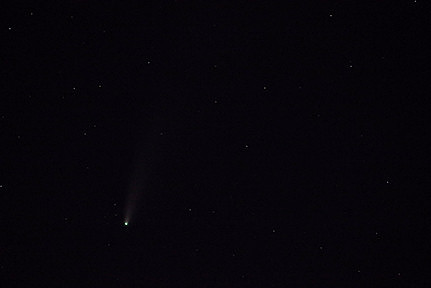
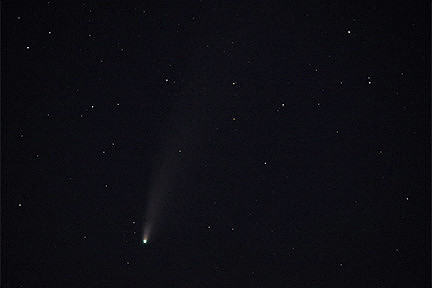
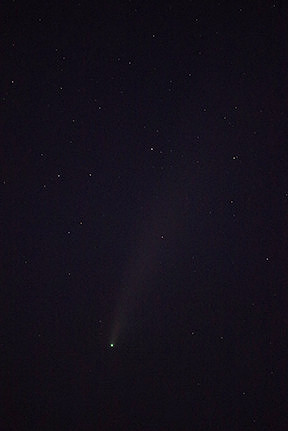
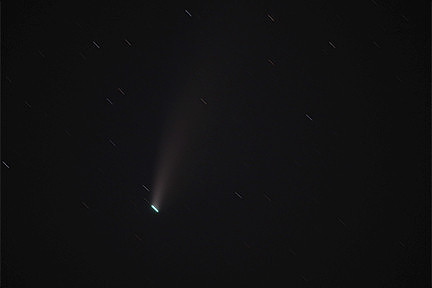
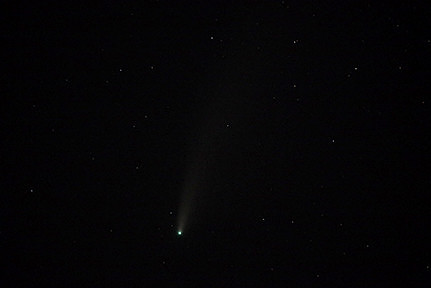
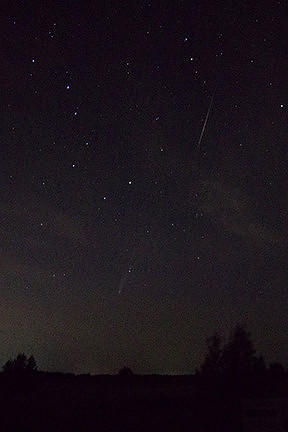
Not as many folks came by that evening, though a few from the night before returned. The woman who had helped point out the right area of the sky before had gone across the street after a short time. She had apparently decided to go straight there this time around, as I never saw her again, but her voice carried across on the breeze. It was actually thanks to her that I spotted the comet. As the Big Dipper came into view, I heard her yelling excitedly in the distance behind me. I started scanning the sky below the bucket, and there it was! It was super faint, and it was easier to see looking just to the side of the area it was located at. I grabbed my big lens and cranked the ISO to try and find it. It was easier to find than I thought it would be once I knew where to look. Focusing, however, was another story. After a few blurry shots, I turned around and used Jupiter to try and focus better before reacquiring the comet. I took quite a few shots over the next hour, trying out different settings. For the most part, I stayed at the full 450mm, as even at that range, the comet was very small in the frame. I tried both vertical and horizontal shots using different ISOs. Generally speaking, I stuck to around 2 seconds. At the long focal length, that was still too long, causing a small amount of star trails, but anything shorter was just too faint, even with the high ISO. Likewise, attempting to lower the ISO just wasn’t really working.
I also experimented a little with my wide-angle lens on my other camera. The shots were fun, but nothing more. I hadn’t brought a second tripod and didn’t have a plate on it at the moment anyway, so I simply resorted to balancing it atop my big lens or the gimble to the side of the lens. Overall, it was a fun night. I knew I wasn’t going to get anything spectacular, but I was ok with that. How could I hope to compete with photos of the comet over castles, Stonehenge, mountains, etc? The fact that I was out there, seeing and photographing the comet was more than enough for me. Eventually, the mosquitoes chased me away, so I said goodnight to the few other folks still there and headed home.
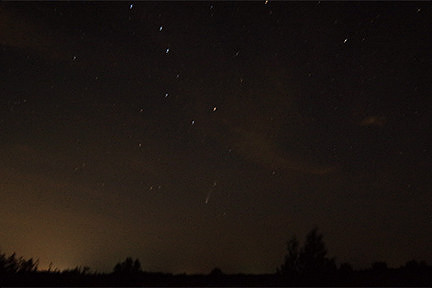
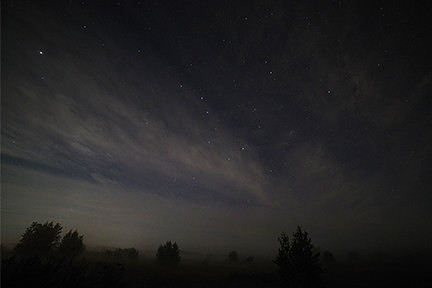
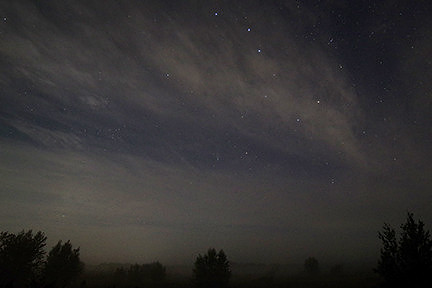
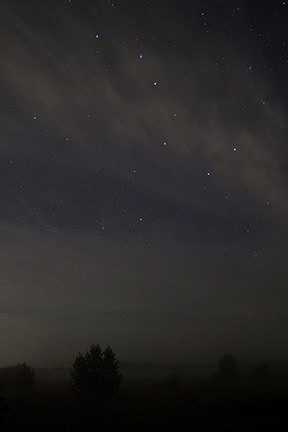
The week passed by with mostly cloudy skies, as I’d expected. I wasn’t too bummed about that since I didn’t have the energy to go out anyway. Finally, the weekend came around once more. As evening fell, the clouds started to build, but I suspected that night might be my last chance. I waited until 9pm this time before gathering my gear to head back to the Blueberry Plains. I decided to concentrate more on photos of the comet with the landscape and left the big lens at the house. There were only two cars there when I arrived. As I came out of the treeline, my jeep was enveloped in a thick fog, but there were stars visible overhead. I asked the others if they’d had any luck, and though they’d seen it other nights, nothing yet. I went ahead and set up my camera on the tripod, knowing its sensor would have a better chance of picking up the faint comet if the thin clouds weren’t fully blocking it from sight. Sure enough, there it was, super tiny in the frame, but visible nonetheless. With the 14mm lens, I was able to do longer exposures and still keep the stars from trailing, allowing for a bit more experimentation. The fog was ebbing and flowing, softly illuminated by the setting moon. The wispy clouds were partially obscuring the comet and the Big Dipper, so each photo was its own unique composition. I even attempted a longer exposure of a few minutes just to see the effect. It wasn’t long enough to really draw out the star trails, but the movement and color of the clouds and fog made it one of my favorites.
The comet was never really visible to the eye that night, thanks in part to the bright moon and to those wispy clouds. The others didn’t stay long, and unlike the previous weekend, no one else showed up. I was alone, and it was beautiful. Before too much time had passed, however, the clouds thickened and covered the comet completely. I packed up my gear and headed home. After a week, I was hearing that the comet had been getting fainter and fainter each night as it moved farther away from Earth. I decided I wouldn’t attempt to go out again, as I knew that it likely would be too dim for my equipment to pick up at that point. I wasn't disappointed, and I was satisfied with the photos I did manage to capture. They’re good record shots and reflect a very special moment in time, an experience that I hope to never forget. I’m so grateful I had a chance to see the comet, even though the circumstances weren’t perfect. Life isn’t perfect, and any chance we have to experience something amazing is worth it.
**For those interested, the official name is C/2020 F3 (NEOWISE), though it’s commonly referred to as Comet Neowise. NEOWISE is actually an acronym for the mission and telescope that discovered it. NEO is for Near-Earth Objects, what the telescope was looking for, and WISE is for Wide-field Infrared Survey Explorer space telescope. It’s common to name comets after the person or telescope that discovers them, so, in future, there could potentially be other comets that have the “NEOWISE” moniker. This is why it also has the official letter/number designation of ‘C/2020 F3’. |