Wildlife Photography: Steller’s Sea Eagle
January 29, 2022
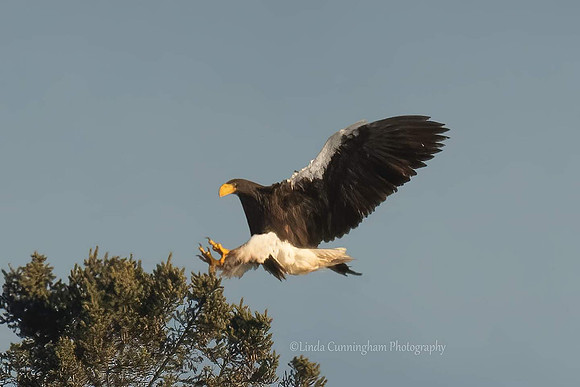
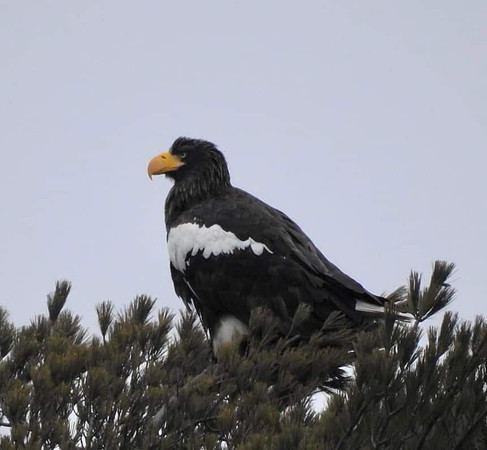
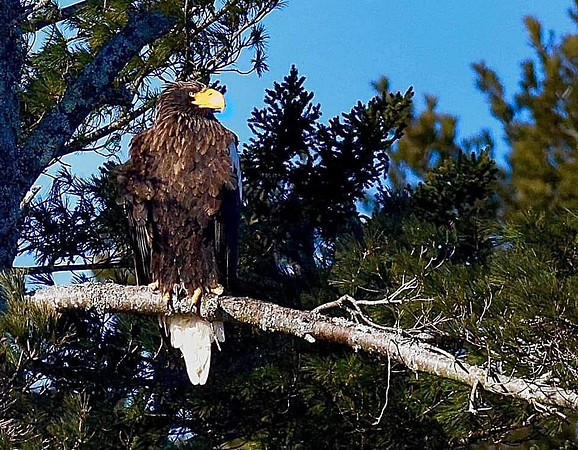
In December 2021, I started seeing reports online about a Steller’s Sea Eagle that had been seen in eastern Massachusetts. This piqued my curiosity, as this huge eagle is native to Japan, Korea, and far-eastern Russia and China. I did a little research and soon found that this particular bird was doing a grand tour of North America. Apparently, it had first been spotted in Alaska, something that wasn’t too hard to imagine given the close proximity of the Aleutian Islands to its native range. They aren’t common in Alaska but have been known to show up from time to time. Then, this bird was spotted in Texas. That sighting was by a single person and so was never officially confirmed. The next time it was spotted was in eastern Canada, where it spent a few weeks on the Gaspé Peninsula in Quebec and in New Brunswick. It was the first recorded sighting of a Steller’s Sea Eagle in Canada. The next time it was seen was in Massachusetts. This was the first confirmed sighting in the lower 48. Birders from all over the country were discussing the sighting and trying to determine if they could make the trip to Massachusetts to see it. News agencies were picking up the story, as well. It was all very exciting. I had a brief thought about trying myself, but I quickly dismissed it. I’ve been dealing with a lot of anxiety the last few years, and the idea of driving down towards Boston with all that traffic was just too terrifying. We were still in the midst of a pandemic, as well, so I couldn’t reach out to anyone to ask if they’d like to go on an adventure with me. It just wasn’t really feasible at this point in time. I wasn’t disappointed, however, because it was far enough away to justify not going, and there’s always the chance I could see them in their native territory on a future trip. After a few days, the eagle left that location, and people began speculating about where it would go next. Then, right at the end of December, it was spotted again, this time in Georgetown, Maine! I followed the reports closely and looked at all the photos being posted in the Maine Birds group and began to wonder if I might get a chance. Georgetown was much closer, much more doable. However, with Christmas and New Year’s on a Saturday this year, my first chance to get time off wouldn’t be until New Year’s Day itself.
When the holiday dawned, the weather wasn’t great. It was rainy, foggy, and cloudy. Bobby and I headed to Scarborough to do some errands. Afterwards, the rain had mostly stopped, but the visibility was terrible. I didn’t even bother asking if he’d like to give it a try figuring there’d be no way we’d actually manage to see the eagle in that weather. All the images were showing the eagle out on an island, and with that visibility, it’d be a miracle if you could even see the island, let alone any birds on it. After a couple of days in Georgetown, the eagle then moved on to Boothbay Harbor. He seemed to really like that area, sticking around for several weeks. Social media and major news outlets exploded with stories about the eagle. I saw so many amazing photos of the eagle as people from all over the country flocked to Boothbay for a chance to see him.
On Sunday, January 16th, it was finally my chance. The weather was supposed to be beautiful, at least in terms of blue sky and sunny, and there hadn’t been any storms for a while, so the roads would be good. The only issue was the temperature. It was supposed to be negative numbers with the wind-chill, so I wasn’t sure if I could stand being out for very long. Bobby and I packed up and left the house just past 8am. We stopped for gas, then hopped on the Pike to head north. We arrived in Boothbay Harbor around 9:30am. The plan was to head to the Maine State Aquarium, which was closed but had public parking and was a great place to start the search based on everything I’d been reading online. By the time we turned onto that road, loads of cars were passing us in the opposite direction. I knew we were going the wrong way. Sure enough, we spotted two wildlife photographers walking back to their car, so I pulled over and asked. They said the bird had moved over to Spruce Point Resort across the harbor. We turned around, and after Bobby pulled up the new information on the map, started heading that way. The traffic was insane. As we got further out of town once more, the road narrowed. I just kept hoping the resort would have a parking area, and at the very least, I’d be able to turn around even if there was nowhere to park. I never found out. More and more cars were parked on the side of the road, eventually blocking the way entirely. I had to back down the road, with several vehicles behind me doing the same thing, and other vehicles in front of me yelling for me to get out of the way. Eventually, I came to someone’s driveway and was able to pull in so I could turn around. I left the area, trying to get out of the jam of people and cars as quickly as possible. I ended up driving all the way back into town before pulling into a church’s parking lot. This was not at all what I had planned. I had not expected all this chaos, nor of knowing generally where the bird was but being unable to get to the spotting area to look for it. I decided to give it one more try. I packed up all my gear and left Bobby with the jeep in the parking lot. I started the long mile and a half walk back towards the resort. It was really hard, as I hadn’t been prepared for a hike. My camera and big lens were on the tripod slung over my neck and shoulders, as I had no other way to carry them. It was very uncomfortable and tiring, and I honestly have no idea how folks do that all the time. I stopped to rest a lot but eventually made it to a section of road where the ocean was just below me on the right. I paused to rest once more and soon had several people pulling up asking if I had seen the eagle. I explained I was just resting on my way to the resort, and a few of them told me the eagle had moved out to one of the islands in the harbor. Apparently, you could see the island from there, so they decided to set up their scopes to look. I decided to hang around and see what they found rather than continuing on. Far across the harbor, there was a Bald Eagle in a tree. More and more people showed up, and they explained to the newcomers that it was just a Bald Eagle. I set up my camera just to see if I could even get anything at that distance. I had the 150-450mm lens and a 1.4 extender, and I could barely make out the Bald Eagle. It was more just a splotch of brown and a splotch of white than anything else.
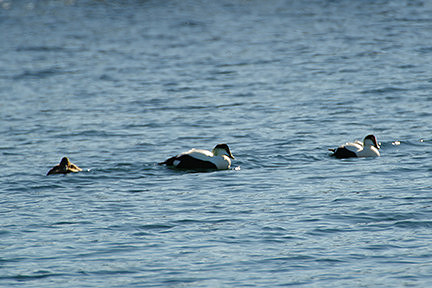
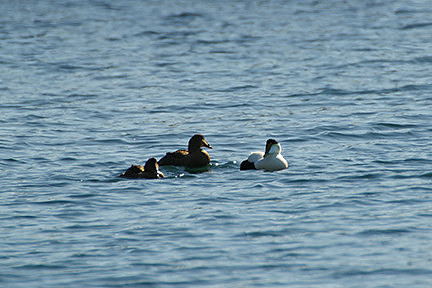
In the water nearby, however, there were several birds floating about. I wasn’t sure what they were but knew I didn’t have any photos, so I made my way down onto the rocks to try to get some images. The sun was glaring off the water’s surface, making it very hard to see. Surprisingly, even though the water was calm, the birds were bobbing around quite a bit, making it much harder than I’d imagined. I wasn’t sure if I managed to get any good photos or not.
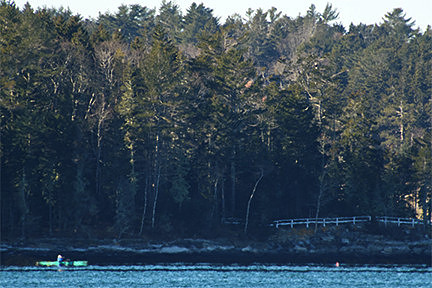
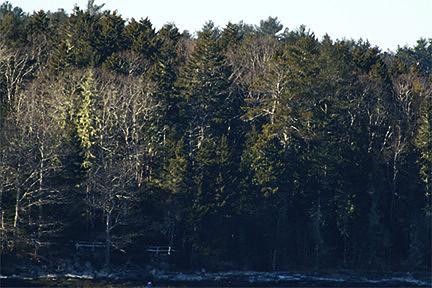
While I was attempting to photograph the local birds, I could hear all the birders and photographers above me talking. Someone said that the Steller’s Sea Eagle was above the kayaker, about 100 feet or meters or yards to the left of the Bald Eagle. Then, they all started exclaiming that they could see him, giving directions to others of where to look. I swung my camera around to try and look, but I had no luck. I could see the kayaker but couldn’t see what they were talking about. I tried taking some photos, thinking that maybe I’d be able to zoom in on the computer and see it, even though it’d be a bad photo. But, no luck. There was just way too much shimmer, too much atmospheric distortion due to the distance and cold temperatures. I couldn’t even get the kayaker to appear in focus.
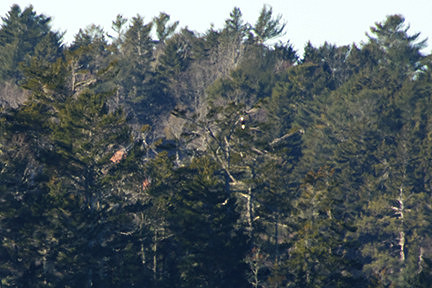
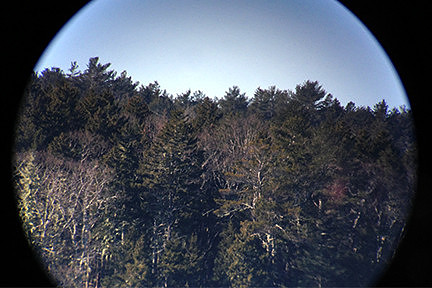
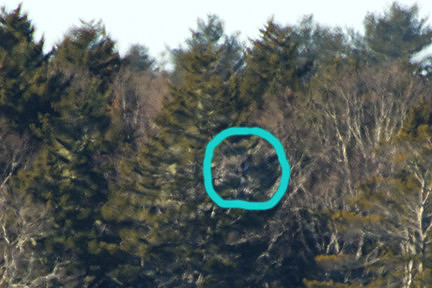
Before long, I gave up and started to pack up my things. I climbed back up the rocks and asked one of the birders if I could peek through her scope. She agreed, so I stepped up and looked through. She told me to look for the Christmas-type tree about halfway down from the top on the right. She said the eagle’s back was to us, so I’d see brown feathers with the white streak on its shoulder. I saw what she was talking about, but I couldn’t say with 100% certainty that it was the Steller’s Sea Eagle. It was just too fuzzy and didn’t look like any of the photos I’d seen of it. I thanked her anyway and tried to get a photo with my cellphone to look at later, but just like with my camera, nothing was in focus.
By 11:50am, I was heading back to town. The road had become a sea of vehicles once again, so it was slow going. They were all parked illegally on the side of the pavement, half sticking into the road, allowing only one vehicle at a time to go by. Because of this, the only place I could walk was in the middle of the road itself, as the cars were butting up right against the rocks or bushes lining the road. Any time a vehicle came along, I had to step between two parked cars to wait before continuing. I was asked a lot of questions by newly arriving birders and given a lot of dirty looks by locals who thought I was standing next to my own vehicle. Eventually, I made it out of the circus and was able to walk more steadily and safely on the side of the road. As I headed back into town, I met a local who told me the eagle often went to this one particular location in the afternoon to fish. He recommended I head over that way, as it was nearing the time when the eagle usually showed up. I would have loved to take his advice, but unfortunately, it just wasn’t an option. Both Bobby and I had stuff we had to do back at home before going to work the next day, so we were going to have to head out as soon as I got back to the car. I thanked the man for the tip and continued on my way. It was around 1pm by the time I made it back to Bobby and the jeep. I was utterly exhausted, both mentally and physically. I hadn’t expected to do any hiking, and carrying my gear across my shoulders and neck like that had not been a good idea. The crowds and the chaos had peeked my anxiety numerous times. And, I was sorely disappointed with how the day had gone in terms of wildlife viewing, let alone photography.
Before we had left, I had this idea of how the day might play out. I thought we’d drive up to Boothbay and head to the parking lot at the aquarium. If we were really lucky, a few other folks would be there, able to point out the eagle, and I could sit on my stool and watch it for a bit, maybe even get some photos. Then, when the cold became too much or it flew off, I’d pack up, and we’d head out. Conversely, if no one knew where it was, we’d drive around the area, scanning treetops, shorelines, and buildings for it together. I would have happily enjoyed either of those scenarios, even the second one if we didn’t end up finding the eagle in the allotted time. Not seeing the specific animal when you’re searching for it is a normal part of wildlife photography. I was prepared for that. I never imagined, however, that I’d know where the eagle was but be unable to see it, unable to even reach the viewing location due to the sheer numbers of people. This was an entirely different type of failure, and I hadn’t been mentally or emotionally prepared for it at all. I stowed my gear in the jeep while telling Bobby everything that had happened, then we headed home, feeling more disheartened than I’d expected. The Steller’s Sea Eagle disappeared from the area just over a week later. It was last seen on January 24, 2022. It’s possible it might show up again somewhere else in New England or Canada, or it might move farther afield once more. We have no way of knowing, but for now, that one day was the only chance I had to try and see it in the Boothbay Harbor area. In the end, though, that’s ok. That’s what wildlife photography is really like. Sometimes, you get lucky, and are able to find and photograph the animal you’re looking for on your first try. Sometimes, you only have one shot, either from a rare animal that has stumbled into a new territory temporarily or from a chance encounter when you’re not looking for the animal. Most times, however, it takes patience and perseverance, going out time after time before it pays off, you find the animal, have the encounter you wanted, and get the images you hoped for. So, here are a few tips to keep in mind if you ever have an opportunity like this, a once-in-a-lifetime event because an animal is not in its usual habitat. First, unfortunately, as bad as it sounds, there’s a good chance that you might not end up seeing the animal. Go with the hope to see it but the realization that it might not happen. Second, there’s the possibility that if you do see the animal, you may not have the chance to get a good photograph of it. Successfully seeing an animal is still a success and something to be proud of even without breathtaking photos. Third, if you’re going to make the time to try to search for a rare animal, allot enough time to actually try. It’s better to have a whole day or a couple of days, rather than just a couple of hours, as it will increase your chances for success and reduce the chances that you have to leave just when you finally found it or hear that others found it shortly after you left. Fourth, be mentally prepared for crowds. If the animal is truly a rare find, it will draw lots of other people to try to see it. Some of them will be remarkably kind and helpful, while others, unfortunately, won’t be. Always be courteous, no matter how others are acting. Follow the local rules, don’t park illegally even if everyone else is, and don’t trespass. And, remember, respect the wildlife you’re there to see, even if others are not. Lastly, above all, try to have a good time. You’re outside in nature trying to find something amazing, and that alone is something to treasure; if you succeed, that’s simply a bonus, a cherry on top to end a great day out. |