Advent of Digital
April 16, 2016
The summer of 2003 was a turning point for me. I had two big trips planned. The first was a 15-day trip to Ireland with my oldest brother. The second, just a few short days later, was another 15-day trip, this time to the Shetland Islands for an archaeological field school with a few professors and fellow students from the University of Southern Maine.
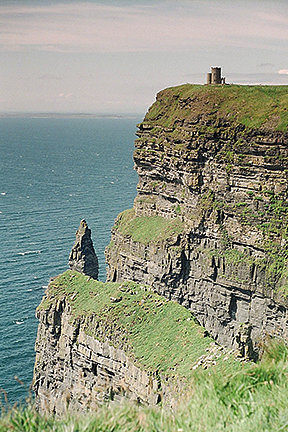
O'Brien's Tower, an observation tower for tourists at the Cliffs of Moher built in 1835. Doolin, County Clare, Ireland While in Ireland, I noticed that the film advance lever on my camera was getting a little loose. It didn’t really give me any problems on that trip, but I wasn’t able to get it checked out by Alan and Andy before it was time to head back overseas. In Shetland, the problem became noticeably worse. I started to worry that it might break off entirely if I took too many photos.
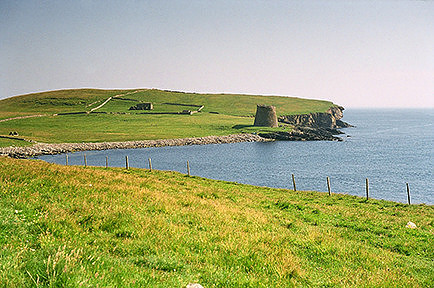
Mousa Broch, the tallest and best preserved Iron Age round tower, and the Haa, an old farmstead seen on maps dating back to the late 1800s. Shetland Islands, Scotland, UK Since I couldn’t very well not take photos, I had to do something. Luckily, one of the first few days in Shetland, we went into the capital city of Lerwick. With several hours of free time, I was able to wander around until I found a camera store. They weren’t a repair shop, but they did sell cameras, including some new digital ones. I really didn’t want to get a point and shoot film camera. The idea of having no control and thus potentially producing terrible photos was absolutely abhorrent. I also didn’t want to invest in a manual camera that didn’t take Pentax K-mount lenses. Being a relatively small store in a relatively isolated location, they didn’t have any Pentax cameras for sale. However, I thought it might be ok to go with a digital camera. Even though I wouldn’t have the control I was used to, I’d have the ability to see the image immediately and delete it if it wasn’t any good, trying again until I got one I liked. It wouldn’t cost me anything, aside from the cost of the camera itself. After talking with one of the assistants and looking over their selection, I purchased an Olympus Camedia C-720 digital camera. It was an alright camera. It had a similar shape to my film camera with an attached zoom lens that made it feel very comfortable and familiar. That nice 8x optical zoom gave it the ability to take better quality photos than the digital cameras others in my group had. The memory card, however, was very small, so I couldn’t take many photos.
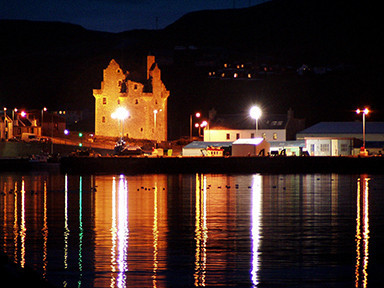
Scalloway Castle at night, taken with my new Olympus digital camera. Shetland Islands, Scotland, UK In the end, I decided to just use my new camera as a backup in tricky lighting situations since it also had a built-in flash, something I’d had to leave at home due to packing/space/weight issues. I continued to use my film camera as normal, figuring that if the lever fell off, at least I had another camera to tide me over on the important shots. It turned out to be unnecessary, as the film camera continued to operate until I got it home for repair. Two years later, I headed back to Shetland for some more archaeological fieldwork before starting graduate school in Bristol, England. I brought two of my cameras with me - the digital and one of my film cameras. I knew money was going to be very tight while living overseas, and consequently, decided I had to be conservative with film. That was ok, though. At some point in the intervening years, I had acquired the largest memory card they produced for my Olympus, a 128 MB SmartMedia SSFD card. This allowed me to take many more photos on a shoot before filling the card up. My plan was to use the digital camera for everything and save the film for only the really important stuff. Even though the memory card still couldn’t hold a whole lot of photos, it was enough for any given shoot. Afterwards, I’d upload the photos to my computer and wipe the memory card so it’d be ready to go again. There were only a couple of times where the card wasn’t big enough. I simply had to be selective in the photos I’d already taken, deciding which to keep and which to delete so I could continue taking more.
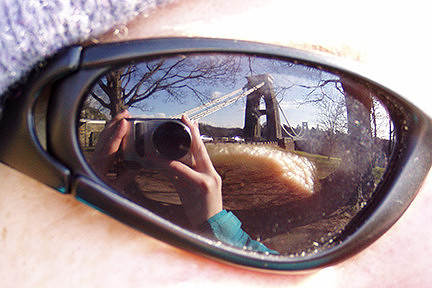
View of Clifton Suspension Bridge reflected in my sunglasses. I spent all day at the bridge getting shots from different angles and experimenting on trying to capture it in the reflection. Bristol, England, UK Since digital was free, it really helped me to grow artistically. It gave me the freedom to try multiple angles and compositions of any given subject to learn to be more creative. By the time I returned home, I had really grown as a photographer. Unfortunately, since I limited the use of the film camera, I became rusty with the technical aspects of photography. I had gotten used to the automation of the digital camera, and somehow forgot how film sees the world, as opposed to a digital sensor. It was a very depressing realization. For that reason, over the next several years, I went back to using my film cameras almost exclusively. My goal was to take what I had learned from digital, being more creative and experimental, relearn the technical side, and combine them to make better photos than ever. Part of that, too, was learning new cameras. Both of my Kalimar cameras had been repaired so many times, and had gotten to the point of almost continuous light leaks, that I decided it was time to replace them. I had a few mishaps, some unfortunate issues with several cameras, before finally lucking out with a good quality used one - a Pentax K1000. Then, in 2009, I booked a big train trip to visit most of the US. I had borrowed my sister-in-law’s small digital camera earlier in the year on a trip to New Mexico for self-portraits. Since I usually travel alone, my family and friends were always complaining about not seeing any photos of me in the places I’d go. In the past, when people have tried to take photos of me with my film camera, it’s never worked out because they didn’t understand it was fully manual. Her little camera did the job well, and I was ready for an upgrade. I wanted a digital camera that would give me a bit more control, was smaller and easier to carry, could take more photos at one time, and be something I could hold and take a photo of myself easily that would also show a bit of the location at the same time. I did a lot of research and decided on purchasing a Panasonic Lumix DMC-ZR1 digital camera. It was a great little camera, a point and shoot with an 8x optical zoom that had a lot of menu settings to allow for more control. I planned on using it for the self-portraits, but also any time I was in a great location. I wanted to have a few photos that I knew for sure were great. I’d had too many issues with the film cameras over the previous years, not to want that insurance just to be on the safe side.
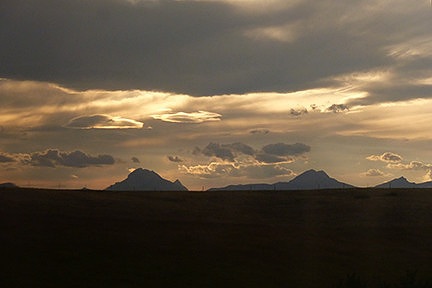
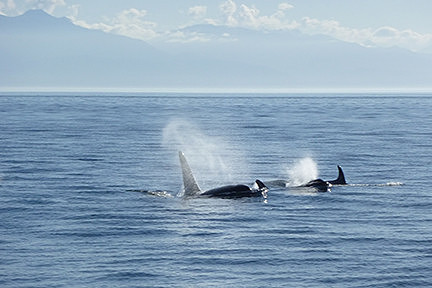
View of the Rocky Mountains from the Amtrak train. As the little Panasonic was still new, I was experimenting with different settings and really liked how this photo came out. Browning, Montana In the end, I used it even more than I’d planned. It was a lot of fun to use on the train itself, taking photos of meals, the people I met, and even of the scenery as it sped by, simply to document my trip. I used it exclusively on a walking trip through Chicago during my layover, getting some nice shots of Buckingham Fountain. The images I captured with it in Mt Rainier National Park and Olympic National Park were very encouraging. And, it worked really well on a whale watch tour out of San Juan Island for some great photos of Orcas and Dall’s Porpoises.
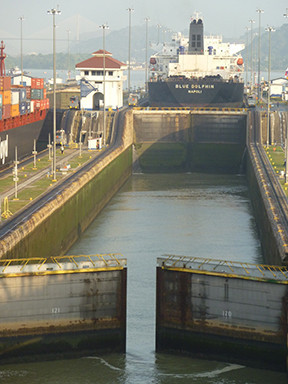
Orcas and the Olympic Mountains in Haro Strait. These were members of J-Pod, the J-2 Matriline. We had Samish (J-14), Riptide (J-30), Hy'shqua (J-37), Suttles (J-40), and baby Se-Yi'-Chn (J-45) pass by. San Juan Island, Washington The following year, I took my surrogate mother on her dream vacation - a cruise through the Panama Canal. I brought both my digital and film cameras with the idea of using the digital for the same purposes as on my previous trip. Unfortunately, when we got home and had the photos developed, the film ones just couldn’t compare. The quality of the digital photos was just so much higher, and there were no issues with dust spots or scratches on the negatives or partial double-exposures.
Passing through the Miraflores Locks in the Panama Canal. Corozal, Panama More and more of the photo labs in my area were shutting down. The one lab I had used for years, Maine Photo Express, was still in business, but I wasn’t sure for how much longer. The owners were talking of retiring sometime in the near future. By this point, Alan and Andy had also closed up their store in Biddeford. They were still doing repairs via mail, but didn’t have the camera store any longer. I was getting frustrated, not only with the uncertainty of where I could get photos developed in future or get supplies or repairs, but also with the quality of my photography in general. I couldn’t deal with the expense and disappointment anymore of the way the photos turned out every time I returned from a trip. I was getting better artistically, but not technically. There was too much time from taking a photo to seeing the print for me to remember the specifics and thus be able to improve. The digital photos showed that my compositions were getting better. But, the film just seemed to be holding me back. So, I made the decision to put up my film camera and make the switch fully to digital. For the rest of 2010, I shot only with my Panasonic. I did a lot of research, and by January of 2011, I knew what I wanted. On a train trip to Alabama, I had a long enough layover in New York City to visit the B&H camera store, where I purchased a Pentax K-7 digital SLR. I was finally able to use all my lenses and work fully manual once again but with all the benefits of digital. And, in 2015, I purchased my second Pentax K-7 so that I would have not only a backup camera but be able to have two lenses available at all times for multiple scenarios. While I believe this was the best decision I’ve ever made, I still have my film cameras stored away in a safe place. Every lens I purchase, I make sure that it not only has fully manual capabilities, but it is compatible with both my K-7 and my film K1000. I like knowing that I could still grab a roll of film and go out with my old camera to make photos. There is not only a nostalgic aspect to the film camera but also a different type of quality in prints made from film as compared to digital. And, to give that up, to turn my back on those possibilities for artistic expression is like being cut off at the knees. Keeping those tools for future use is a must, at least for me. ~ ~ ~ ~ ~ ~ ~ ~ Click here to see more photos from my time living in England. |