The Animal Connection
October 15, 2016
I have always loved animals, so much so that I thought I was going to be a veterinarian. It wasn’t until my first year of college, when I happened to watch a show on TV, that I realized I didn’t have the heart for it. Or, rather, my heart was too big and couldn’t take it. The show was one of those animal surgery shows on the Discovery Channel or something similar. It was about a yellow lab puppy with a brain tumor. They did surgery and saved its life, and the puppy grew up and lived a wonderful life, I’m sure. It was a happy ending. But, that didn’t matter. I cried like a baby through the whole show and continued crying for most of the rest of the day. That’s when I decided not to get a medical degree. It’s taken me a long time to realize how much losing that connection has affected me. When I made that decision, I chose to follow the archaeology path for the rest of my college career. I was also doing my photography, but it centered mostly on landscapes, whether natural or cultural. Granted, whenever I happened upon some sort of animal, I’d smile at the chance to photograph it, but I didn't go out of my way looking for those opportunities. Part of me felt empty, and it’s only been in the last few years that I’ve been able to put my finger on why. I love animals and need to have them be a focus in my life, not just a coincidence. That’s when I decided to have animals as one of the main focal points in my photography.
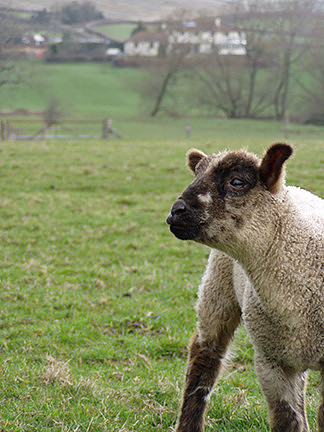
A little lamb at an archaeological site I was visiting in grad school. I wasn't there for the sheep, but I took the opportunity that presented itself for a cute photograph. Stanton Drew, England, UK Making that decision is great, but it’s not the end of the story. You can’t just snap your fingers and instantly be a great animal photographer. It’s more than having the right gear and knowing the technical aspects, as well. You have to learn about the animals. You have to figure out which poses and behaviors make for interesting photographs, as well as what the different behaviors are telegraphing about the animals’ intentions. You need to understand not only which lighting and focus areas work best, but also what types of lighting situations you’ll most likely find each type of animal in. You need to know which situations call for ‘environmental portraits’, where they work best, and when close-ups work best instead. And, when doing close-up portraits, you have to determine where on the animal it’s ok to crop and where it’s not. In other words, you need experience and practice! You don’t want to make the same mistake I did. I went off to the Himalayas to search for snow leopards as part of a tour. I’ll tell the full story another time, but the important piece right now is that I didn’t practice first. So, when we saw the snow leopards, I sat there, not taking any photos, waiting for them to turn their heads. Then, they disappeared over the ridge. I got exactly one photo before they disappeared - of their torsos and tails. Not good! If I had practiced, I would have realized how silly it was to wait for them to pose perfectly and would have taken other photos when I could still see both animals completely. When I got back from the Himalayas, I realized I couldn’t do that again. I needed practice and lots of it before taking any other wildlife photography trips. Some people are lucky in that they live in a location with abundant wildlife. Some people aren’t, but that shouldn’t prevent you from pursuing animal photography if that’s your passion. I say, use whatever opportunities you have close at home to practice. If that means shooting your pets, and your friends’ and family’s pets, do it. If it means going to the zoo or aquarium, do it. Do whatever it takes to get the practice you need. I live in southern Maine. While there is a lot of wildlife in the state, it’s not readily visible. You can drive for days and go trekking for miles without seeing anything. Often, when you do see something, it’s just a fleeting glimpse, too fast to get a photo. I have seen a handful of moose, numerous deer, several great blue herons, a bear, a few rabbits, porcupines, raccoons, wild turkeys, squirrels, chipmunks, multiple songbirds, eagles, a beaver, and some groundhogs in my meanderings while living in this beautiful state. But, I only have a handful of photos from all those sightings.
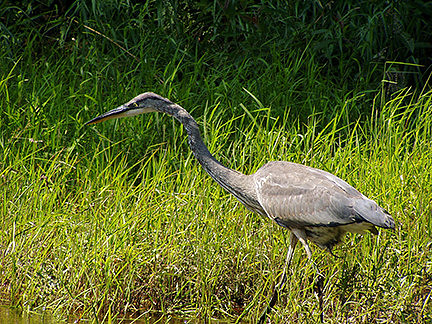
I was kayaking along a small stretch of the Saco River between New Hampshire and Maine and found this Great Blue Heron fishing. I was amazed to see him and even more so that he let me get close enough for a photograph. I've only ever seen them at a distance before. Conway, New Hampshire
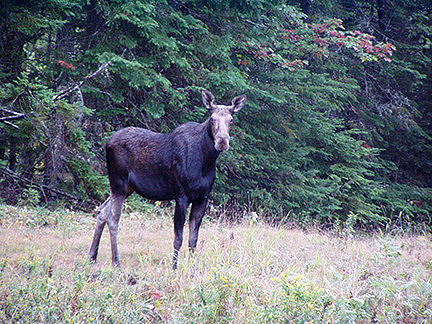
A cow (female) Moose on the side of the road. In the past, whenever I've been lucky enough to see a moose, it was either crossing the road in the distance and gone by the time I reached the spot or I wouldn't have my camera on me. This gal was munching the grass between the road and the treeline and was kind enough to hang out while I got a photo of her. Dallas Plantation, Maine We have a small zoo that’s open during the summer months down in York, about 45 minutes or so south of me. We have another place in Gray, about an hour or so north of me, for rescued native Maine wildlife. There’s also a zoo down in Boston that’s open year-round, as well as an aquarium for marine life. Finally, there are some wildlife tours available here in Maine. Some of them are geared towards moose and other woodland creatures in the interior of the state. Others are geared toward whale watching and other sea creatures off the coast. So, I made the decision that I’m going to try each of these places and opportunities whenever I can. I have to make it a priority. My first practice photo shoot was on the fourth of July last year. I had the day off from work due to the holiday and decided to head down to York’s Wild Kingdom for the day. I had a really great time and took almost 800 photos at the zoo that day. I didn’t try to photograph every animal there. I just picked a few and spent quite a bit of time with each one, taking lots of photos.
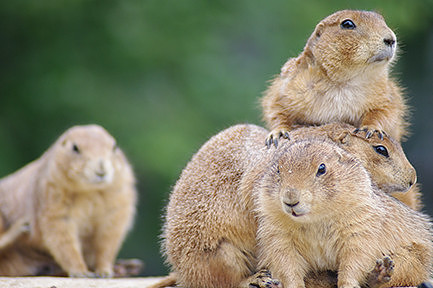
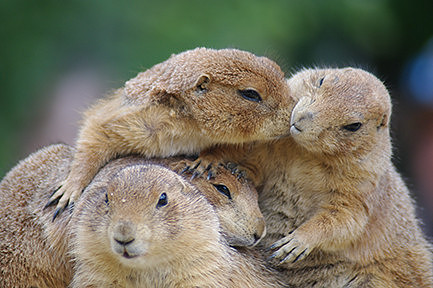
I spent at least an hour with these Black-Tailed Prairie Dogs. I tried zooming in for closeup shots and pulling back to have more of the scattered clan in the frame. I also tried focusing on different animals to see what worked best for depth of field, amongst other experiments. York's Wild Kingdom, Maine
While some of them didn’t move around a lot, it still gave me the chance to try different camera settings and different focus areas. It allowed me to start to learn which head positions were more interesting in a photograph. Since I focus manually, it also taught me quite a bit when dealing with the animals that did move a lot, such as the monkeys and lemurs. Those guys were so fast that it helped me to speed up my fingers both with the focus and with pressing the shutter.
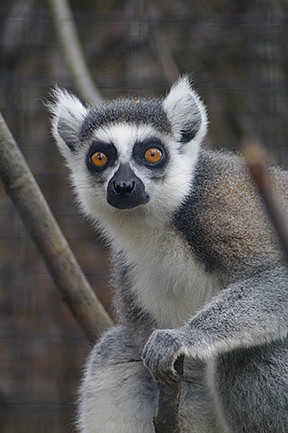
This Ring-Tailed Lemur certainly did move around a lot. I got some great practice focusing and composing with him moving so much. I have a lot of blurry photos of him and his buddy, but it was definitely worth it to be able to get a shot like this. York's Wild Kingdom, Maine All in all, it was a really great day. I learned a lot and had a wonderful time outside and in the company of lots of fantastic animals. I definitely plan on going back again for more photo ops and recommend the place to anyone in the area. In the latter half of the summer and early fall last year, I went on several whale-watching tours to get experience for those types of animals. I used the two different companies local to my area - Odyssey Whale Watch in Portland and First Chance Whale Watch in Kennebunk. For each tour, we went out about 20 miles offshore to different ledges where the whales are known to feed. You are on the wide-open ocean, and they are wild animals, so there is never a guarantee of any sightings, but we were quite lucky each time. We had numerous sightings of Minke whales, the smallest of all the baleen whales. They move really fast and are quite difficult to photograph. We saw a Finback whale on one of the trips, the second largest of all the whales and of all animals currently living on the planet. For both of these whales, you tend to see only the back and the dorsal fin. If they are diving, there’s a bit more of an arch to the back, but that's it. You don’t typically see the fluke (tail), and with the Minke, you don’t even see the blow. It was interesting to learn how to get good photographs of these whales when you typically think of Orcas and Humpbacks and the awe-inspiring photos they can produce.
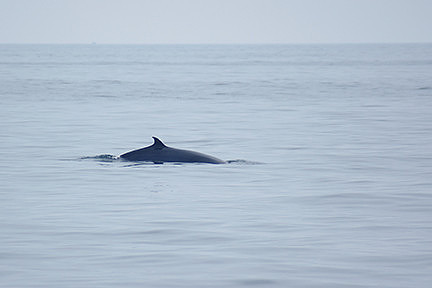
A Minke whale seen on one of the whale-watch tours. We saw quite a few, but I only have a small number of photos because they move so quickly. Portland, Maine
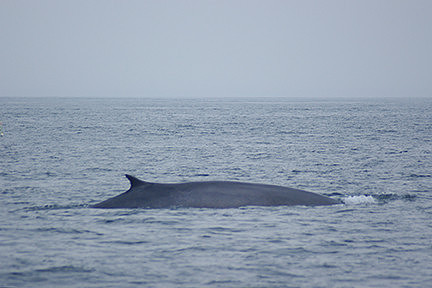
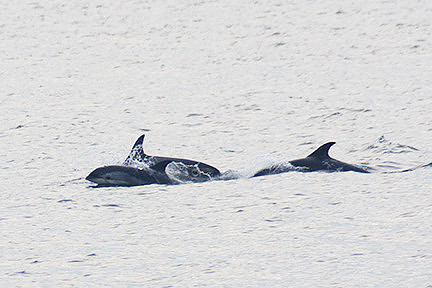
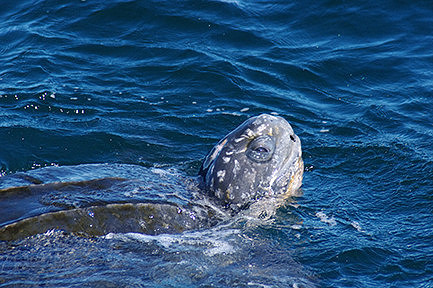
The Finback whale we saw on one of the tours. He didn't stick around long, but he was quite close to the boat and was moving slow enough for us all to have some great looks and a few chances at photos. Portland, Maine We had a lot of Harbor Seal sightings and a few Harbor Porpoise sightings, but it was almost impossible to get their photos. The Harbor Porpoises tend to be very shy and will swim away as quickly as possible when a boat is in the area. This was very different from one day when we had a pod of Atlantic White-sided Dolphins racing the boat. I think the best day was when we came upon a Leatherback Sea Turtle and were able to keep him company for a little while. All the trips also had plenty of bird life, as well, which always makes for good photography practice. They say that one of the hardest things to capture is a bird in flight.
These Atlantic White-Sided Dolphins were moving really fast. They were around for a short time, racing the boat, but they were super difficult to get a photo of. I have a lot of photos of empty water or a bit of a splash and no animals. This is my best one and is actually cropped in quite a bit from the original just so they'd be visible here on the blog. Portland, Maine
This Leatherback Sea Turtle was just hanging out when we came upon him on one of the tours. He stayed with us for quite a few minutes, so we were all able to get plenty of photos. The hardest part was the exposure, what with the sun glinting off his wet skin and the water cascading off his shell. Portland, Maine Both tour companies were really great. The ships were pristine, sturdy, and quite comfortable, even when we had some moderate chop to the waves. The crews were wonderful, not only telling us about the animals, but also about the area as well, in terms of history and culture. All in all, I had a really great time and learned a lot about marine animal photography while I was at it. I plan on going back out again in future, and I would certainly recommend both companies to anyone looking for a great day out to sea. As I said before, if you have the passion to want to photograph animals, you need to do whatever you can to satisfy that dream and get the practice. This doesn’t mean you can only get it from expensive trips to far-off places. Go to the local zoo or aquarium. Visit a farm or a riding stable. Photograph your pets or the pets of those you know. Even a pet store would work. Animals are everywhere. We just have to put a little effort into paying attention to what’s around us. They all give us practice and are worthy subjects, from the smallest insects to the largest mammals. I have really enjoyed my practice photo shoots, and if animals are your passion, I think you will too. I plan to continue taking them whenever possible, and will write about more of these little adventures in the future. ~ ~ ~ ~ ~ ~ ~ ~ Click here to see more of my early animal photography. |